Early-Middle Miocene lacustrine clay minerals, protodolomite, and carbonates in the Hançili Formation (Ankara, Türkiye): mineralogy, sedimentology, and paleoclimate
DOI:
https://doi.org/10.13133/2239-1002/18719Abstract
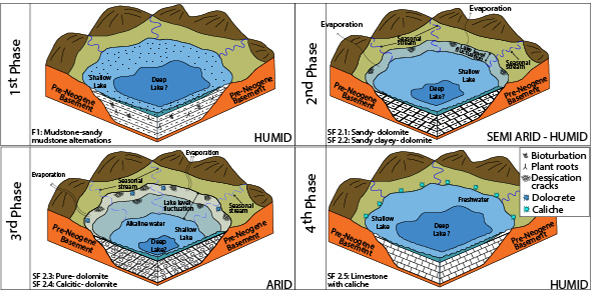
This study aims to determine the paleoenvironmental and paleoclimatic evolution of the Early to Middle Miocene Hançili Formation in the SW Çankırı-Çorum Basin (Ankara-Çubuk region, Türkiye), developed during the Neo-Tethys closure. Mineralogical, sedimentological, and geochemical properties of lacustrine sediments were analyzed by XRD, SEM, and XRF. The shallow lacustrine system is divided into four depositional phases: (1) mudstones deposited from suspended loads in shallow lakes; (2) sandy and sandy clayey dolomites representing mixed lacustrine/dry margin with seasonal fluvial influx; (3) pure and calcitic dolomites indicative of arid and drying alkaline lake; (4) freshwater limestones with caliche, reflecting humid conditions. XRD analysis identified dolomite, protodolomite, calcite, quartz, feldspar, amphibole, and clay minerals such as smectite, palygorskite, sepiolite, chlorite, and illite. The presence of protodolomite suggests early diagenetic precipitation under variable geochemical regimes preceding complete dolomitization. The occurrence of palygorskite and sepiolite suggests episodic evaporitic conditions and magnesium enrichment. Geochemical weathering indices (CIW, CIA, PIA) indicate moderate to intense chemical alteration in the source area. These findings indicate the Hançili Formation preserves evidence of four distinct climatic stages and documents lacustrine dynamics controlled by climatic fluctuations, regional tectonics, and sediment supply.
Downloads
Published
Issue
Section
License
Copyright (c) 2025 Periodico di Mineralogia

This work is licensed under a Creative Commons Attribution 4.0 International License.