Evaluating the role of geological formations in the heavy metals concentration in the Qarasu River and Gorgan Bay, North of Iran
DOI:
https://doi.org/10.13133/2239-1002/19013Abstract
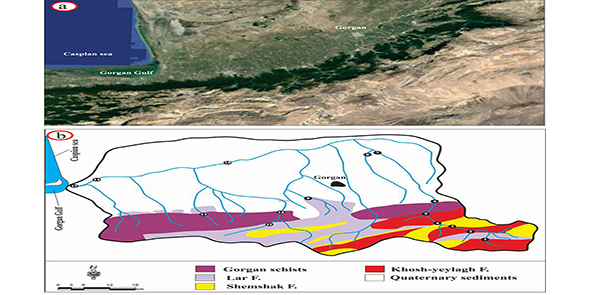
The catchment area of the Qarasu River is among the most important water suppliers to Gorgan Bay. It is located in the north of Iran, in the southern part of the Caspian Sea. This study investigates the role of geological units in the accumulation of heavy metals in the sediments of the Qarasu River and Gorgan Bay. To this end, 21 samples (rock, sediment, and water) were analyzed using the Inductively Coupled Plasma Mass Spectrometry (ICP-MS) method. The value of heavy metals in the studied samples are approximately for cobalt 1-27 (average 13 ppm), chromium 134-7 (average 88 ppm), copper 6-59 (average 32 ppm), nickel 1-76 (average 42 ppm), lead 1-49 (average 23 ppm), vanadium 8-185 (average 100 ppm), zinc 9-157 (average 99 ppm). The concentration of heavy metals progressively increases as one moves away from the river’s source toward the coast of Gorgan Bay. In general, the main sources of heavy metals are the Gorgan schist and the minor Shemshak formation. Human involvement in the concentration of heavy metals in the Qarasu River and the shores of Gorgan Bay is very low to rare.
Downloads
Published
Issue
Section
License
Copyright (c) 2025 Periodico di Mineralogia

This work is licensed under a Creative Commons Attribution 4.0 International License.