Identification of Au and Cu epithermal and porphyry potentials using the geochemical mineralization probability index, zonality index and fractal modeling in the Bostan Abad region, NW Iran
DOI:
https://doi.org/10.13133/2239-1002/19037Abstract
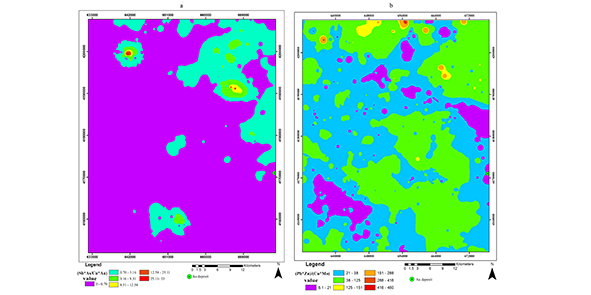
This study aims to identify the geochemical anomalies of Cu and Au using stream sediment geochemical samples, geochemical maps, geochemical mineralization probability index (GMPI) and an extended zonality index derived from a staged factor analysis (SFA) using a fractal model in the 1:100000 geological map of Bostanabad. The results of factor analysis show that Cu was on factor F3-1 with Fe, Zn, V, Mn, Pb and Au on factor F3-3 with Hg. The C-N fractal approach was used to classify the GMPI data to determine Au and Cu anomalies, and the southern and central regions of the study area exhibit these anomalies. In addition, the zonality index for the two factors F3-1 and F3-2, which were determined after a three-stage factor analysis, was based on the elements associated with the epithermal Au deposit type using the equation (As×Sb)/(Au×Cu), while the Cu-Mo porphyry deposit type was determined by the equation (Zn×Pb)/(Cu×Mo). Subsequently, these zonality indices were categorized using C-A fractal modeling. Significant anomalies of this elevated zonality index and GMPI are associated with plutonic units and silicification as well as the intersections of faults, especially in the northeastern and northern sectors of the Bostanabad region. The data were factor analyzed using factor analysis, GMPI and zonality index to determine the association between the elements and classify them by paragenetic elements using the fractal method. Finally, the largest Cu and Au anomalies are found in the northern and northwestern regions. Field observations and petrographic analyzes, which include polished and thin section evaluation and XRD data, show the presence of pyrite and chalcopyrite mineralization associated with the intrusive rocks in the region. In addition, there is evidence of alteration and silicic dykes in the Eocene pyroclastic layers.
Downloads
Published
Issue
Section
License
Copyright (c) 2026 Periodico di Mineralogia

This work is licensed under a Creative Commons Attribution 4.0 International License.