Nanoscale investigation of silver in galena from Lavrion and Chalkidiki mines using microscopic and spectroscopic techniques
DOI:
https://doi.org/10.13133/2239-1002/19125Abstract
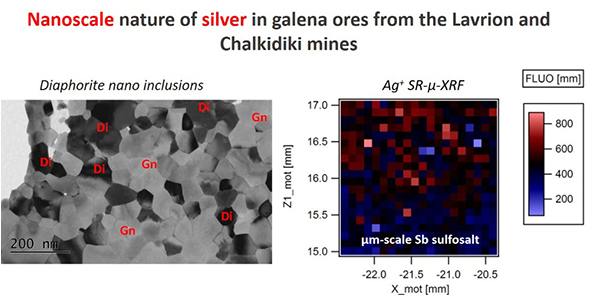
The nature of silver (Ag) in “pure” galena (PbS) crystals from the historical mines of Lavrion (Attica, Greece) and the Kassandra Mines (Stratoni and Olympias, Chalkidiki, Greece) is investigated in the present study using transmission electron microscopy (TEM) and synchrotron X-ray spectroscopy. The phase composition in the Lavrion sample is complex, including both the presence of nanominerals (Sb-sulfosalts, namely diaphorite-type [Ag3Pb2Sb3S8], in the size range of 10-500 nm) and Ag+ incorporated into the galena structure at concentrations between 0.11 and 1.83 wt%, as determined by TEM-EDS. In contrast, TEM analysis of the Chalkidiki galena revealed no Ag-bearing phases at the nanoscale, unlike in the case of Lavrion. Further investigation attempted via synchrotron X-ray spectroscopy confirmed the presence of Ag+ both within the galena and in Sb-sulfosalts with which the galena phase is associated at the macroscopic and micron scales. Therefore, it is concluded that in Lavrion galena, silver occurs both as diaphorite nanoparticles and as Ag+ incorporated into PbS following a coupled substitution mechanism (Ag++Sb3+↔2Pb2+), while in galena from the Chalkidiki mine, the absence of other metals and metalloids at the nanoscale suggests that Ag appears to be either close to Ag0 or, more likely, related to a PbS-Ag2S solid solution.
Downloads
Published
Issue
Section
License
Copyright (c) 2026 Periodico di Mineralogia

This work is licensed under a Creative Commons Attribution 4.0 International License.