Fluid inclusion and Pb–O isotope constraints on the genesis of the Jurassic Karaburun VMS deposit (Central Pontides, Türkiye)
DOI:
https://doi.org/10.13133/2239-1002/19139Abstract
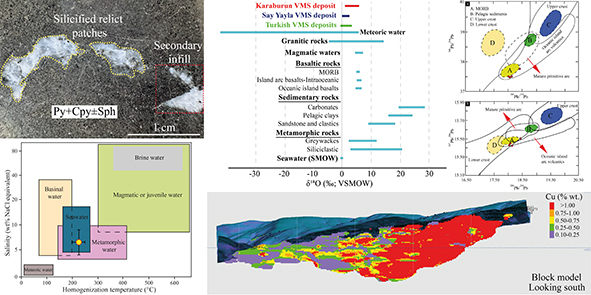
The Jurassic Karaburun deposit in Central Pontides is the largest known VMS deposit in Türkiye, containing ~125 Mt of ore averaging 1.16 wt. % Cu, 0.25 wt. % Zn, and 0.05 wt. % Co. Mineralization occurs within low-grade greenschist rocks of the Çangaldağ Metamorphic Complex, a tectonic unit of the Central Pontides. It is associated with volcaniclastic, detrital, and deep-marine sediments, along with cross-cutting mafic dikes and sills. The mineralization is predominantly stratiform, forming sheet-like to tabular bodies with disseminated, banded, pyritic clastic, semi-massive, and massive sulfide textures.
δ18O values of quartz in different ore textures range from 11.79‰ to 14.40‰, corresponding to calculated hydrothermal fluid values of 1.22-4.20‰ V-SMOW. Fluid inclusions with two phases (liquid + vapor) in the quartz of mineralized sections show eutectic temperatures of −10.9 to −26.0 °C, final ice-melting from −0.8 to −7.5 °C, and homogenization temperatures of 178-301 °C, with salinities of 1.4-11.1 wt. % NaCl eq. (avg. ~6.5 wt. %). Pressure corrections indicate minimum trapping temperatures of ~223 ± 25 °C. Microthermometric, oxygen isotope data and formational settings of the deposit collectively indicate ore-forming hydrothermal fluids are seawater-dominated H2O–NaCl fluids slightly and likely modified by magmatic fluids/volatiles. Narrowly constrained, non-radiogenic Pb isotope ratios (208Pb/204Pb= 37.463-37.751; 207Pb/204Pb= 15.424–15.503; 206Pb/204Pb= 18.079–18.431) indicate a mantle-derived source for lead in the massive sulfides and they also conform to the global lead evolution curve while showing temporal consistency with the growth of ore lead.
Downloads
Published
Issue
Section
License
Copyright (c) 2026 Periodico di Mineralogia

This work is licensed under a Creative Commons Attribution 4.0 International License.