Archives
-

Vol. 9 No. 2 (2026)
This is the first issue where accepted papers are published immediately after full copyediting.
-

Special Issue, "What is Life?"
Vol. 9 No. 1 (2026)Produced with the Levin Lab at Tufts University, this special issue addresses the question, What is life? Sixty-eight researchers collaborated with Levin Lab to discover hidden conceptual archetypes among various definitions of life. Definitions were documented in an email symposium which was analyzed by machine learning. Biological Theory (Springer) published the analysis as 'What lives? A Meta-Analysis of Diverse Opinions on the Definition of Life'. Here you can find the unabridged email symposium prefaced by a theoretical introduction.
-
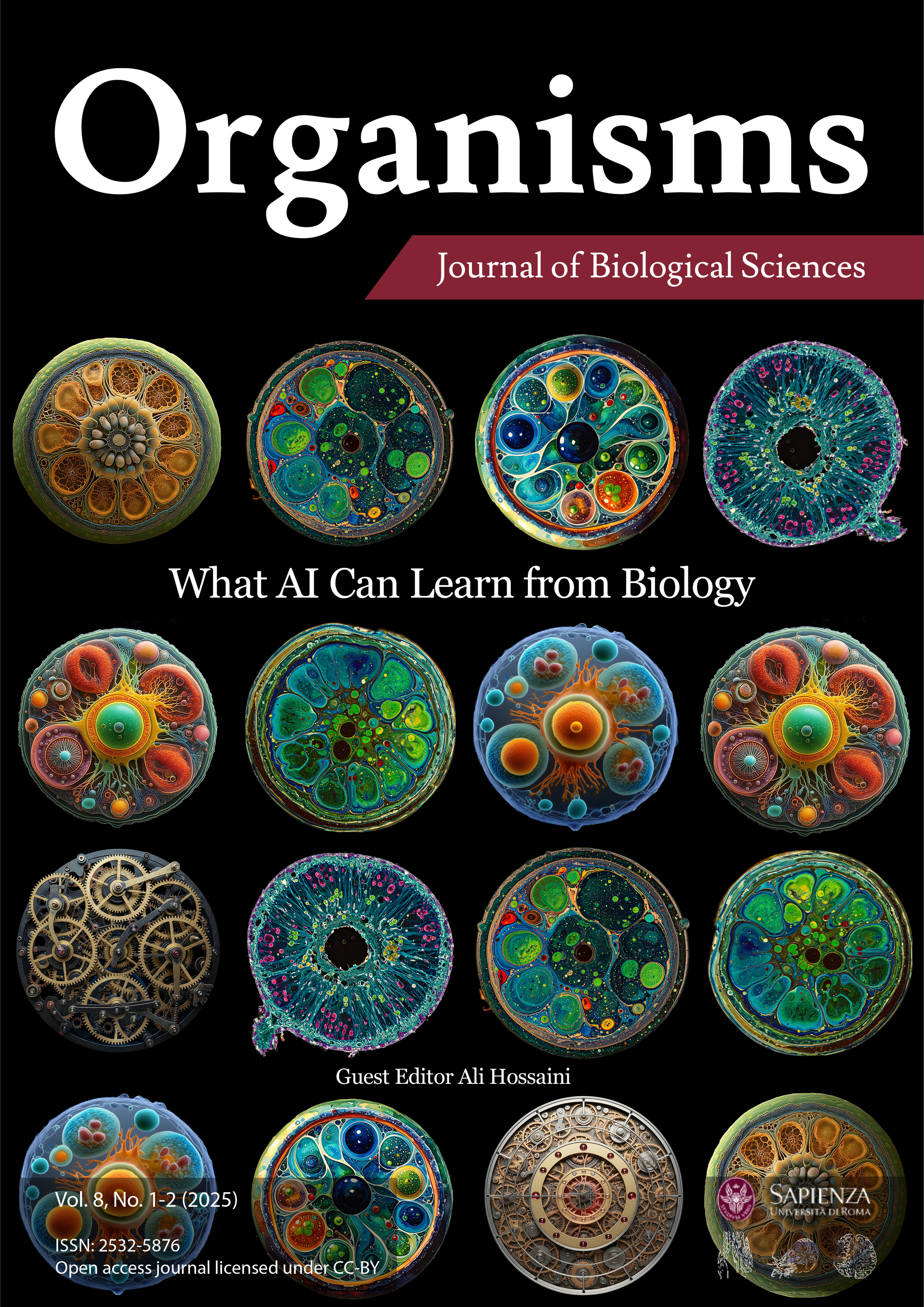
Special Issue, “What AI Can Learn from Biology”
Vol. 8 No. 1-2 (2025)This special issue uses AI to cast light on the nature of life. Many assume that life emerges from a blend of information and complexity. If this is the case, then we might expect a future generation of machines to exhibit lifelike behavior or, as some would claim, to come alive. Two perspectives are offered for considering the question of life: agency and intelligence. Intelligence is associated with information, rationality and consequent knowledge representations, while agency associates with embodiment, judgment and material organization. Predictions about machine life rely on conceptions of intelligence, but the addition of agency to the analysis of life and lifelike behavior results in nuanced conclusions that can beneficially inform regulation and future research.
Guest Editor, Ali Hossaini
-
Upper Limb Structural Anatomic Mechanisms of Protection (SAMPs). Ahead of Print, December, 30 2021
Introduction Nature has provided living bodies with extraordinarily effective reparative mechanisms. Furthermore, the biological processes involved in anatomical structures are designed to protect life against external injuries. A series of these protective systems in the upper limb are herein described. Material and Methods From 2009 to 2017, 864 fresh frozen cadaveric upper limbs were dissected from the axilla to the fingers during the Italian Hand Society surgical anatomy dissection course. Results Arrangement of anatomical structures in the upper limb is able to protect major life supporting organs. Conclusions External injuries affecting the upper limb may cause damage to many important structures resulting in severe functional impairments. The layout of the structures and the relationship between them are organized to preserve life at any functional cost.